Off-grid sanitation technology succeeding at Cape Town pilot sites
03 March 2025
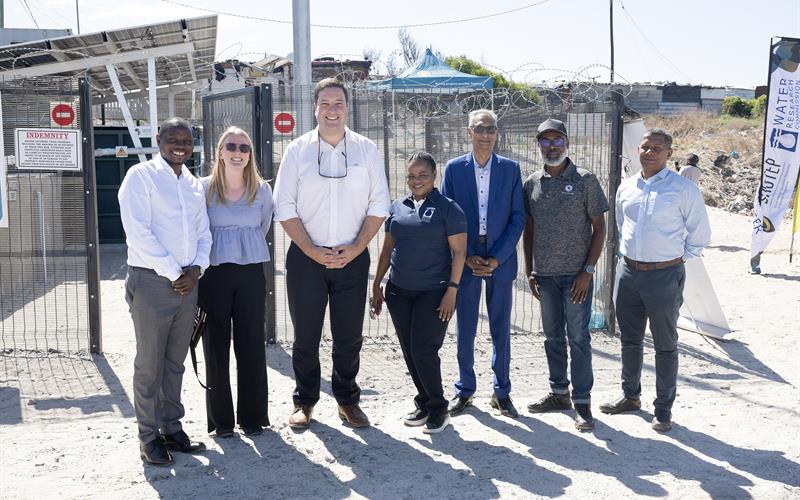
Innovative ‘off-grid’ sanitation technology is now fully operational at Masincedane Informal Settlement in Strandfontein, one of the pilot sites for this City initiative supported by the Water Research Commission and funded by the Gates Foundation. Mayor Geordin Hill-Lewis visited the site together with partners on Monday, 3 March.
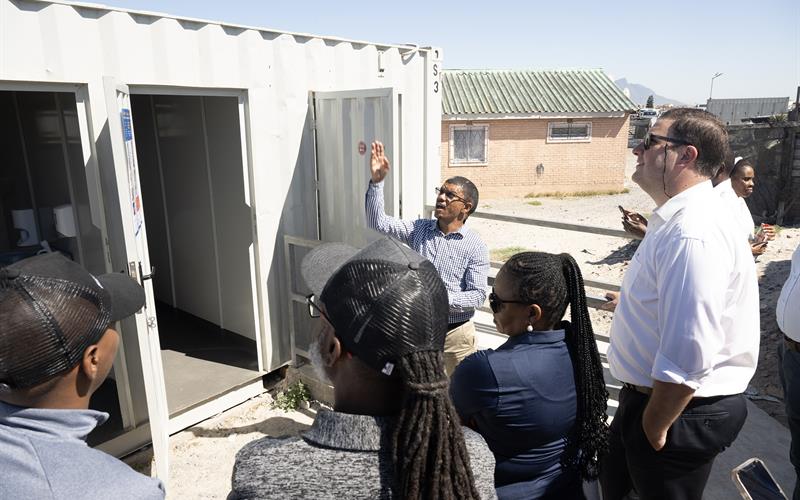
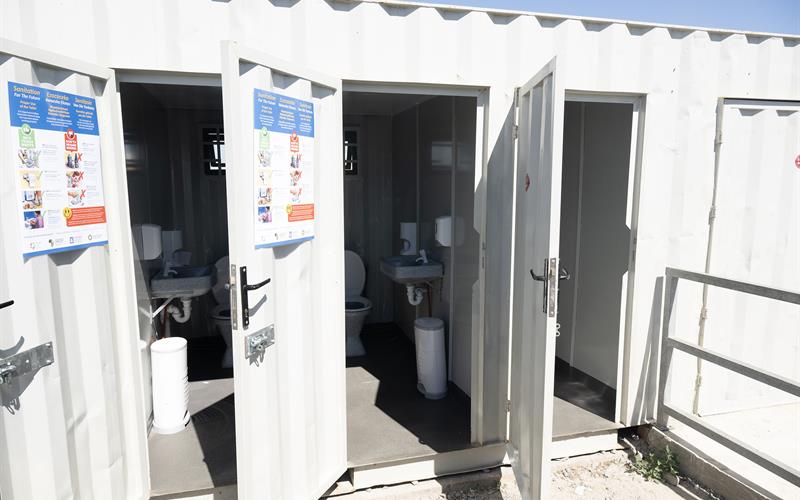
Since its launch in December 2024, the project has seen 17 full-flush toilets installed at Masincedane (Strandfontein) and Nyakathisa (Macassar) informal settlements. Each ablution block consists of three refurbished shipping container modules, connected to an on-site treatment plant, operating independently from the bulk sewer system.
Full-flush toilets were previously only possible with connection to sewer pipes, but this off-the-grid system treats wastewater on site through a membrane biological reactor and ozone disinfection. The treated water is then recycled for flushing, making it ideal for areas with challenges in connecting to bulk infrastructure.
 This new innovation complements other solutions currently supplied by the City including chemical, container and portable flush toilets (PFTs) where connections to bulk infrastructure are not immediately possible or feasible.
‘I was glad to visit these pilot sites where we’ve successfully installed this innovative toilet technology, which provides access to dignified sanitation to residents living in informal settlements. Already we are seeing improved sanitation for this community as a result of the pilot, which was previously not feasible without the direct connection to sewer pipelines,’ said Mayor Hill-Lewis.
This pioneering sanitation initiative is being undertaken by the City’s Water and Sanitation Directorate in partnership with Water Research Commission (WRC) and funded by the Gates Foundation.
 If these pilots are successful and supported by communities, the City is looking to expand the project to more informal settlement areas.
In order to test the viability of the technology for further roll-out, the City has established a Monitoring and Evaluation working group consisting of officials with multi-disciplinary skills. They are monitoring four performance areas to evaluate the outcome of the pilots including:
• Technical performance (quality of treated effluent, system functionality and robustness of the technology)
• Environmental performance, including regulatory compliance
• Economic performance and financial viability
• Social acceptance (user experience, community feedback, health conditions and safety)
‘The City of Cape Town’s use of innovative, water-efficient, off-grid, non-sewered sanitation solutions to meet the needs of informal communities is not only exemplary in South Africa, but across the African continent and globally,’ said Najib Bateganya, Deputy Director: Water, Sanitation & Hygiene at the Gates Foundation.
‘Innovations like these are improving sanitation services for all and building resilience to the increasing public health and climate challenges we face as a global community,’ he added.
 Positive community experiences at Masincedane Informal Settlement
‘Residents living in Masincedane expressed appreciation for the addition of the new sanitation system.
Prior to the December 2024 handover, extensive community engagement and training workshops were conducted on the use and maintenance of the facilities.
‘This pilot community has been exemplary in taking full ownership and making use of the facilities with the utmost care,’ said the City's Mayoral Committee Member for Water and Sanitation, Councillor Zahid Badroodien.
More informal settlements to benefit Planning for the next three pilot sites at 7de Laan in Strandfontein, OR Tambo in Khayelitsha and Rasta Camp in Ocean View, is in advanced stages, with construction due to commence in March 2025.
These facilities are expected to be commissioned in May/June later this year.
The two different technologies that will be tested at these sites, operate on the same principles of providing off-grid non-sewered sanitation systems; although each has its unique treatment process.
‘This is a significant stride in the City’s efforts to improve sanitation services in areas where the challenges presented by informality require new solutions. The ultimate goal is to test the viability of rolling out similar technology where it is most needed, across Cape Town.
‘Education is key to sustainability. The community is reminded that the system can only run efficiently when used only for flushing the three Ps: pee, poo and toilet paper. If any other items are flushed down, the system will not be able to function properly which will lead to costly blockages and damage to the infrastructure.
‘We are excited about this innovation and the benefits that it can bring if residents are willing to try it, and also help us to look after this service,’ said Councillor Badroodien.
Published by:
City of Cape Town, Media Office